
Table of Contents
- How Federal Rules Define a Commercial Refrigerator
- The Size Lines That Do Exist in Federal Rules
- Why a Big Stainless Fridge at Home Is Still Residential
- What Colorado Food Rules Expect in an Aurora Kitchen
- How We Size a Commercial Refrigerator for an Aurora Kitchen
- Getting the Right Size Refrigerator for Your Aurora Business
- Frequently Asked Questions
A refrigerator is not commercial because it is big. Under federal energy rules, it is commercial because of what it is built to do and who it is sold to, and that changes how you should shop for one in Aurora.
No size makes a refrigerator commercial. The federal definition used by the U.S. Department of Energy covers refrigeration equipment that is not a consumer product and that stores or displays merchandise and perishable materials. It sets no minimum capacity.
The only size lines in those rules sit at the edges of the market. A household unit under 7.75 cubic feet counts as compact, and a walk-in cooler or freezer is defined with less than 3,000 square feet of chilled storage.
For an Aurora kitchen, the more useful question is whether a unit can keep food at 41°F or below under real service. That is what Colorado’s retail food rules ask for.
Here at Climate Alignment, we install, repair, and maintain commercial refrigeration across Metro Denver, including Aurora. We size equipment to the measured load rather than the label on the door, and this post walks through how that works.
Planning a new unit or replacing one that cannot keep up? Contact us and we will look at the load before anyone talks model numbers.
Key Takeaways
- Size does not decide it: the federal definition of a commercial refrigerator has no minimum capacity.
- What does decide it: the unit is not a consumer product, it stores or displays merchandise and perishables, and it runs on a self-contained or remote condensing unit.
- The size lines that exist: household units under 7.75 cubic feet are compact, and walk-ins are defined below 3,000 square feet of chilled storage.
- What Aurora kitchens must meet: Colorado’s rules require cold holding at 41°F or less, enough refrigeration capacity, and a thermometer you can read.
- Certification helps: equipment certified for sanitation by an ANSI-accredited program is deemed to comply with the equipment design rules.
- Efficiency counts: ENERGY STAR certified commercial refrigerators and freezers are on average 20 percent more energy efficient than standard models.
How Federal Rules Define a Commercial Refrigerator
The federal definition of a commercial refrigerator says nothing about cubic feet. Under 10 CFR 431.62, the Department of Energy’s rule for commercial refrigeration equipment, a unit qualifies through what it is and how it works. It must not be a consumer product, and it must be built to store or display merchandise and perishable materials.
The Seven Tests in the Definition
The definition lists seven conditions, and a unit has to meet all of them:
- It is not a consumer product.
- It is not designed and marketed only for medical, scientific, or research use.
- It runs chilled, frozen, a combination of both, or at a variable temperature.
- It displays or stores merchandise and other perishable materials horizontally, semi-vertically, or vertically.
- It has solid or glass doors, sliding or hinged doors, a mix of those, or no doors at all.
- It is designed for pull-down or holding temperature applications.
- It is connected to a self-contained or a remote condensing unit.
Notice what is missing. There is no width, no height, and no cubic-foot threshold anywhere in the list.
What “Not a Consumer Product” Means
The consumer product test does most of the sorting. Federal rules define a consumer product as one that, to any significant extent, is distributed in commerce for personal use or consumption by individuals.
So the dividing line is the market the unit is built for. A refrigerator made for family kitchens is a consumer product, and a refrigerator made to hold a restaurant’s inventory is not.
Self-Contained and Remote Condensing Units
Both setups count as commercial. In a self-contained unit, the compressor, condenser, and fan motors are an integral part of the cabinet.
A remote condensing unit puts that same assembly somewhere away from the refrigerated equipment. That choice changes where the equipment goes and how it is reached for service, which is why we survey the site before ordering a unit.
The Size Lines That Do Exist in Federal Rules
Size shows up in federal rules only at the edges of the market. A household refrigerator with less than 7.75 cubic feet of total refrigerated volume is classed as compact, and a walk-in cooler or freezer is an enclosed space you can walk into with less than 3,000 square feet of chilled storage.
The Compact Line for Household Units
The 7.75 cubic foot line, which equals 220 liters, applies to household refrigerators, refrigerator-freezers, and freezers. It separates compact household units from larger household units.
It does not separate household from commercial. A compact unit sold for home use is still a consumer product, and a large one is too.
The Walk-In Definition
Walk-ins have their own definition under 10 CFR 431.302. A walk-in cooler or freezer is an enclosed storage space, including its panels, doors, and refrigeration system, that can be walked into and has a total chilled storage area of less than 3,000 square feet.
The temperature splits the two. A walk-in cooler runs above 32°F, and a walk-in freezer runs at or below 32°F.
Why a Reach-In Has No Size Cutoff
Between those two edges sits most of the equipment an Aurora kitchen buys: reach-ins, undercounter units, and display merchandisers. For all of them, the commercial test is the design and the market, not the size.
| Equipment | What decides the category | Size rule in the federal definition |
|---|---|---|
| Household refrigerator | Sold for personal use, so it is a consumer product | None, except the compact line |
| Compact household unit | Still a consumer product | Less than 7.75 cubic feet |
| Reach-in or undercounter unit | Built to store merchandise and perishables, not sold for personal use | No size cutoff |
| Display merchandiser | Built to display merchandise, with glass doors or no doors | No size cutoff |
| Walk-in cooler or freezer | An enclosed space you can walk into, with its own definition | Less than 3,000 square feet of chilled storage |
Why a Big Stainless Fridge at Home Is Still Residential
Stainless steel, a tall cabinet, and two full-height doors can make a household refrigerator look commercial. Under the federal definitions, though, a unit sold for personal use by individuals is a consumer product, whatever it looks like, and a consumer product cannot be a commercial refrigerator.
Built for a Household Kitchen
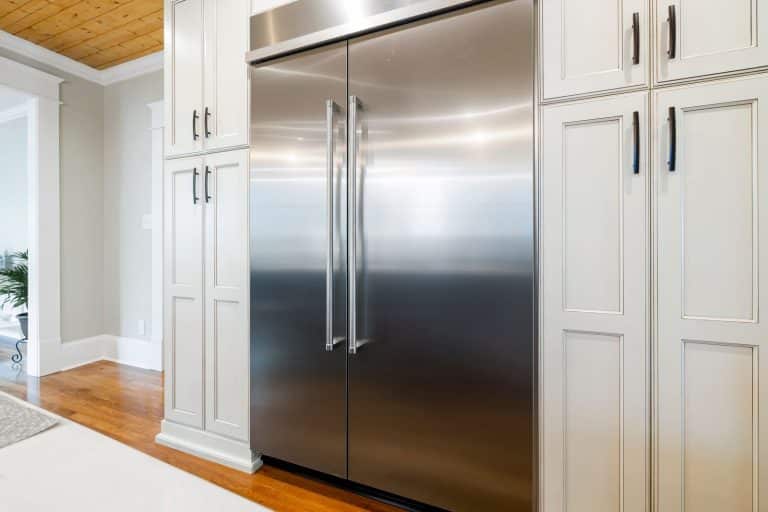
Federal rules describe a household refrigerator as a cabinet that runs on single-phase alternating current only and holds its compartments above 32°F and below 39°F. That describes a unit built for a family’s groceries.
The commercial definition is written for a different job. It covers equipment designed for holding or pull-down temperature applications in a business that stores or displays merchandise.
So a stainless household refrigerator stays a consumer product, even when it is built into the cabinetry and stands as tall as a reach-in. Federal rules for household units sit in Part 430 of the energy regulations, and the rules for commercial refrigerators sit in Part 431. Which part applies depends on the market the unit is made for, not on its finish or its size.
What to Check on the Spec Sheet
Look for a sanitation certification mark from an ANSI-accredited certification program. Colorado’s rules treat equipment certified that way as meeting the design and construction requirements for food equipment.
Then check the listed capacity in cubic feet, the electrical requirements, and the door type against how your kitchen actually works. A spec sheet tells you what the unit is built for, which is the question the federal definition asks.
How long that equipment will last is a separate question, covered in our post on the life expectancy of a commercial freezer.
What Colorado Food Rules Expect in an Aurora Kitchen
In an Aurora restaurant or market, an inspector cares less about the word commercial than about what the unit does. Colorado’s Retail Food Establishment Rules, effective March 16, 2024, ask whether your refrigeration holds food at 41°F or less, whether you have enough capacity, and whether you can read the temperature.
Cold Holding at 41°F or Less
Section 3-501.16 of the Colorado rules requires time and temperature control for safety food to be held at 41°F or less, unless another listed exception applies. Every refrigerator holding that food has to keep up with that number during service, not only overnight.
Enough Capacity for the Load
Section 4-301.11 says equipment for cooling and cold holding food must be sufficient in number and capacity to keep food at the required temperatures. That is a capacity rule, not a size rule.
A unit that holds 41°F with the door shut can still fall behind during a dinner rush. If yours already struggles, our post on why a commercial freezer stops freezing covers the usual causes.
Capacity is measured against the real load, which is why we start there.
A Thermometer You Can Read
Section 4-204.112 requires cold holding equipment for that food to have at least one built-in or permanently attached thermometer placed where the display is easy to see. The sensor goes in the warmest part of a refrigerated unit.
Certified Equipment Is Deemed to Comply
Section 4-205.10 says food equipment certified or classified for sanitation by an ANSI-accredited certification program is deemed to comply with the rules on equipment materials, design, and construction. Buying certified equipment is the simplest way to meet that part of the code.
How We Size a Commercial Refrigerator for an Aurora Kitchen
The right size comes from the load, not from the floor space or a model number. Before we recommend equipment on a commercial refrigeration installation, we measure what the unit will actually face: ambient heat gain, how fast product turns over, and how often the doors open.
Start With What Goes In and How Often
A unit that receives large deliveries has to pull a lot of warm product down to temperature. A unit that stores the same product all week mostly has to hold it there.
Those are different jobs, and the federal definition itself separates pull-down from holding applications. We match the equipment to the one your kitchen actually has.
Count the Door Openings
Every time a door opens, warm kitchen air gets in and the system has to remove that heat. A reach-in on a busy line can face far more openings in a shift than a storage unit in the back.
That is why two kitchens with the same menu can need different equipment. The door count is part of the load, so we measure it rather than guess.
Match the Unit to the Job
Once the load is known, the equipment type follows. A walk-in suits bulk storage, a reach-in suits the line, and an undercounter unit suits a station with little floor space.
Efficiency belongs in the decision too. ENERGY STAR lists solid, glass, and mixed door commercial refrigerators and freezers as eligible, and says a certified commercial solid door refrigerator can save a business 325 kWh and more than $40 a year.
If you are deciding whether to replace an older unit, our guide on whether a 10 year old freezer is worth fixing walks through that call. Keeping new equipment at its rated capacity is the job of commercial refrigeration preventative maintenance.
Getting the Right Size Refrigerator for Your Aurora Business
The size that is right for your kitchen is the one that holds 41°F through your busiest hour, every day of the week. The reliable way to find it is a load measurement taken in your own kitchen, since a label, a stainless finish, or a cubic-foot number cannot show it.
At Climate Alignment, we serve businesses in Aurora and across Metro Denver. We size new equipment, handle commercial refrigeration repair when a unit falls behind, and keep systems running through scheduled maintenance.
To size your next unit against your real load, call us at (720) 836-9565.
Frequently Asked Questions
What size refrigerator is considered commercial in Aurora?
No size makes a refrigerator commercial. The federal definition covers equipment that is not a consumer product and that stores or displays merchandise and perishables, with no minimum capacity. In an Aurora kitchen, what matters more is that the unit holds food at 41°F or less, as Colorado’s retail food rules require.
How big is a commercial size fridge?
There is no single size. Commercial refrigerators range from small undercounter units to large reach-ins and walk-ins, and the federal definition sets no size limit for reach-ins at all. The right size for a business comes from its load: how much product goes in, how often, and how often the doors open.
How can you tell if a refrigerator is commercial grade?
Check what the manufacturer built it for. A commercial unit is made to store or display merchandise and perishables in a business, not sold for personal use. On the spec sheet, look for a sanitation certification mark from an ANSI-accredited program, which Colorado’s rules treat as meeting the equipment design requirements.
Can I use a commercial refrigerator in my house?
Nothing in the federal definitions stops a homeowner from buying one. Before you do, check the unit’s electrical requirements and installation instructions against your home, and read the warranty terms for residential use. Commercial units are built for business loads, so confirm the fit with the manufacturer first.
Is 18 cubic feet a normal refrigerator?
For a household refrigerator, 18 cubic feet is well above the 7.75 cubic foot line that federal rules use to define a compact unit. Federal rules do not define a normal size beyond that. Whether 18 cubic feet is enough depends on how much food you store.
Do commercial refrigerators have to be certified in Colorado?
Colorado’s rules say equipment certified for sanitation by an ANSI-accredited program is deemed to comply with the equipment design and construction requirements. That makes certified equipment the simplest route. Confirm the requirements for your project with the health agency that reviews your plans.
Are ENERGY STAR commercial refrigerators more efficient?
Yes. ENERGY STAR says certified commercial refrigerators and freezers are on average 20 percent more energy efficient than standard models. It puts the savings for a certified solid door refrigerator at 325 kWh and more than $40 a year, and for a glass door refrigerator at 370 kWh and nearly $50 a year.
 Is It Worth Fixing a 10 Year Old Freezer in Greenwood Village?
